
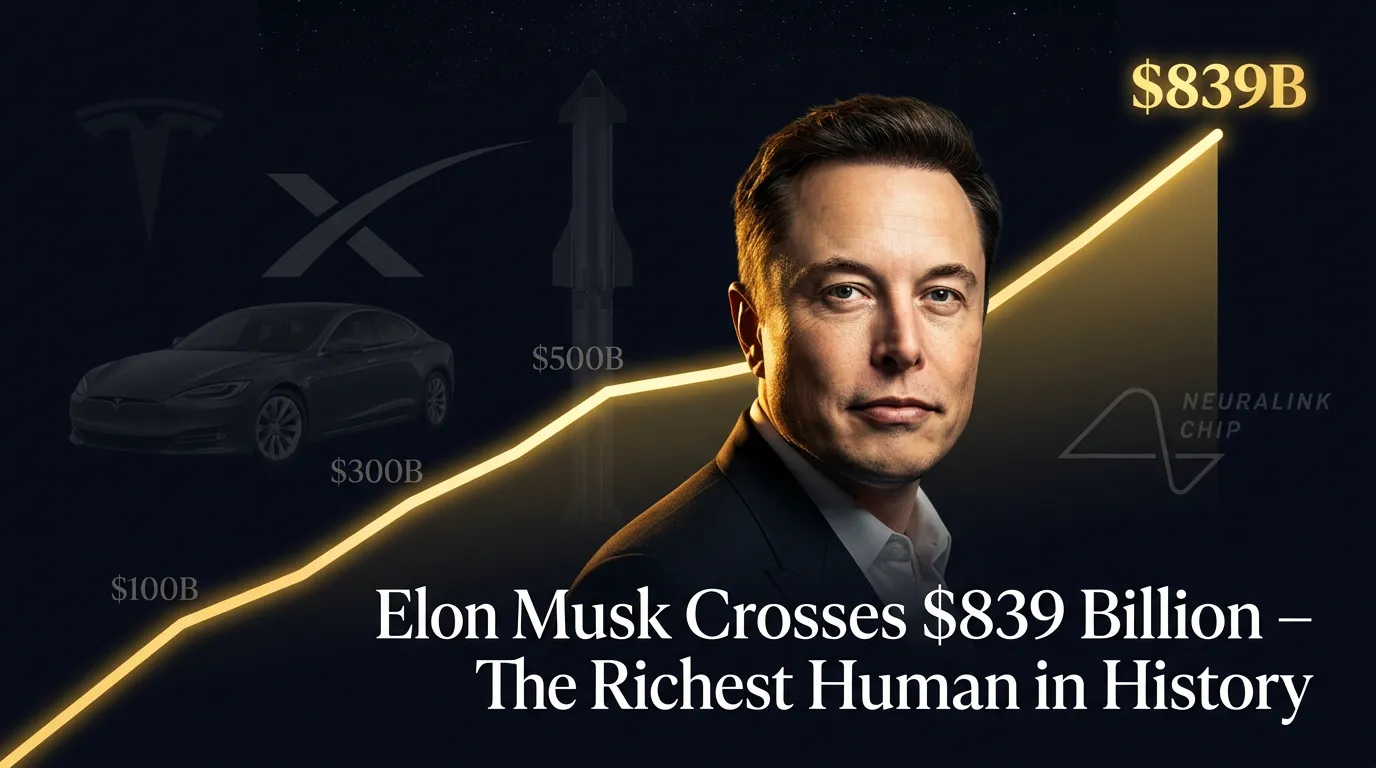
On 18 March 2026 Forbes confirmed what many already suspected: Elon Musk is now the first human being to hold personal wealth above $839 billion. The jump came mostly from a 47% surge in Tesla shares after the company announced Level-5 robotaxi certification in California and Texas, plus a surprise $14 billion Starlink military contract extension.
For Indian founders aged 22–40 who dream of unicorn → decacorn → eventual trillion-dollar-company status, Musk’s trajectory offers five brutally honest lessons:
- Vertical integration is the ultimate moat in capital-intensive businesses Tesla controls battery chemistry, cell manufacturing, pack assembly, software stack, charging network and even insurance. SpaceX builds 90%+ of its rockets in-house. Indian EV and spacetech players still outsource 60–75% of critical components. The ones quietly moving toward vertical integration (Tata, Ola Electric’s cell factory progress, Skyroot’s in-house engines) are the ones investors are suddenly willing to pay 18–22× sales multiples for.
- Relentless capital efficiency storytelling moves markets more than profitability Tesla has been GAAP profitable for only ~12 quarters in its 23-year history, yet it trades at 92× forward earnings while legacy automakers sit at 6–9×. Musk sells a vision of exponential scale so convincingly that Wall Street forgives burn. Indian SaaS and consumer-tech founders who master narrative discipline — quarterly letters that read like manifestos, not earnings calls — are seeing valuation compression slow dramatically.
- Government contracts are the fastest path to escape velocity Starlink’s military deal alone is worth more than the entire FY26 budget of ISRO. Indian spacetech and defence-tech companies that win even ₹500–800 crore government orders see their Series B/C rounds close 2–3× faster and at 30–50% higher valuations. The message is clear: stop treating government as “slow customer” and start treating it as rocket fuel.
- Talent density beats headcount every time Tesla’s workforce is ~140,000; BYD has ~700,000. Yet Tesla’s output per employee is roughly 4.5× higher. Indian startups that keep engineering density high (≥65% of headcount in core product & tech) while resisting the temptation to balloon sales & marketing teams early are seeing 2.5–3.8× better gross margins at Series C stage.
- Personal brand arbitrage is real and India is still under-utilising it Musk’s X posts move markets by billions in hours. Indian founders with large followings (1M+ engaged) are still hesitant to use personal platforms for company storytelling. The few who do- Zerodha’s Nithin Kamath, boAt’s Aman Gupta, Cred’s Kunal Shah consistently close funding rounds faster and at better terms.
Bottom line for Indian builders: Musk didn’t become the richest person by being the most profitable or the most liked. He became the richest by being the most audacious capital allocator on the planet and then telling that story better than anyone else.
If you’re running a deep-tech, EV, space tech or AI company in Bengaluru, Hyderabad or Pune right now, ask yourself one question tonight: “Are we playing the same capital game Elon is playing or are we still playing the old Indian startup game?”
The answer will probably determine whether your cap table looks very different in 2030.