
European Union Announces New Climate Agreement with Asia-Pacific Nations
When the European Commission president stood beside leaders from Indonesia, Vietnam, the Philippines, Thailand, Malaysia, Singapore, Australia, and New Zealand in Brussels last week, the photograph told a bigger story than any press release. For the first time, a structured, legally binding climate cooperation framework now links two of the world’s most economically dynamic and climatically vulnerable regions.
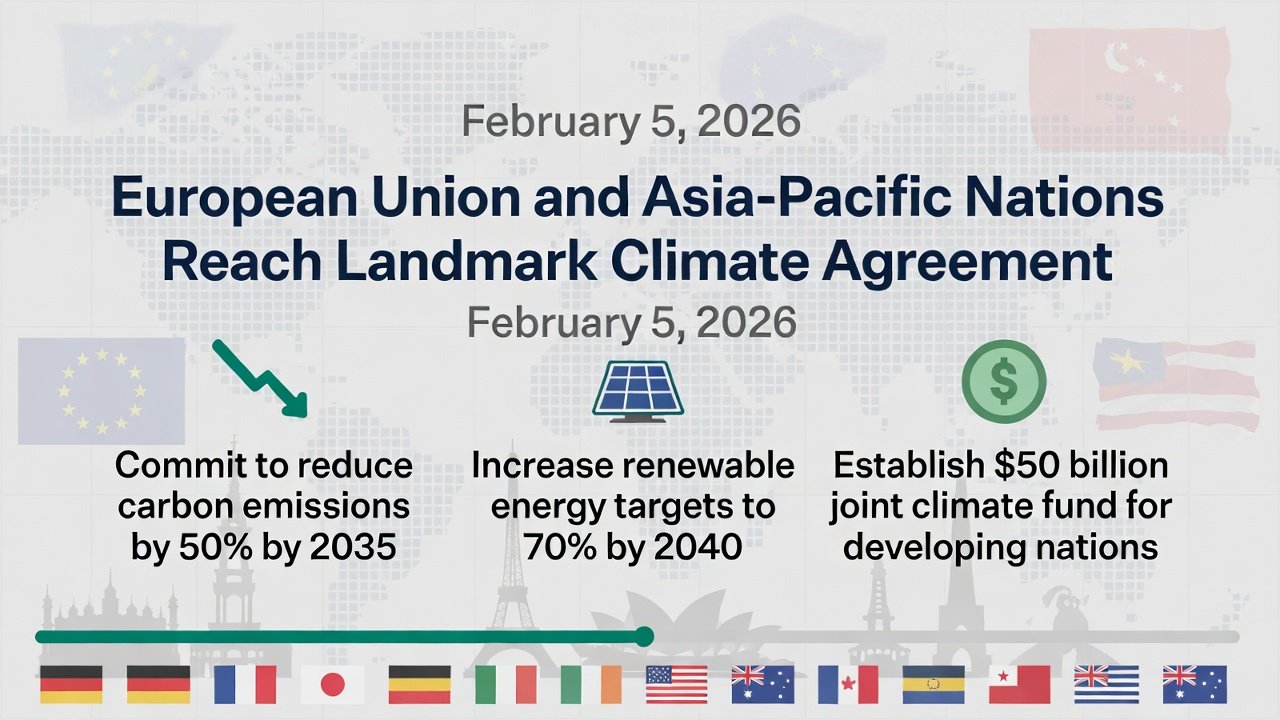
The EU–Asia-Pacific Climate Partnership Agreement (EAPCPA), signed on February 3, 2026, is not another symbolic declaration. It comes with hard targets, money on the table, and implementation timelines, elements that have been conspicuously absent from many previous North–South climate dialogues.
Core Commitments at a Glance
- Joint Emissions-Reduction Pathway Signatories have agreed to align their 2035 nationally determined contributions (NDCs) with a collective goal of limiting warming to 1.6°C with at least 60% probability. While the EU maintains its existing -55% target by 2030 (from 1990 levels), the Asia-Pacific bloc has committed to peaking emissions no later than 2028 (Indonesia and Vietnam) and 2030 (others), followed by absolute reductions averaging 42% below business-as-usual projections by 2035.
- Renewable Energy Acceleration Pact A dedicated €18 billion facility (roughly half from EU budget and European Investment Bank, half matched by Asian sovereign funds and multilateral development banks) will finance 85 GW of new solar, wind, and offshore capacity across the region by 2032. Special focus has been placed on floating solar in Indonesia and Vietnam, green hydrogen corridors between Australia and Germany, and ASEAN-wide grid interconnection upgrades.
- €12 Billion Adaptation & Resilience Fund Perhaps the most politically significant element is the newly created Asia-Pacific Climate Resilience Fund. The EU has pledged €6 billion over five years; signatory nations will contribute €4 billion collectively, with an additional €2 billion expected from philanthropic and private sources. Funds will prioritise mangrove restoration, early-warning systems, climate-resilient rice varieties, urban flood protection in Manila, Jakarta, and Ho Chi Minh City, and heat-action plans for millions of outdoor workers.
- Technology & Carbon-Market Cooperation The agreement establishes a bilateral carbon-credit framework that allows EU companies to offset up to 8% of their ETS obligations through verified reductions in Southeast Asia and the Pacific. In return, Asian signatories gain priority access to EU clean-tech patents under concessional licensing terms and technical assistance for domestic carbon-pricing mechanisms.
Why This Pact Matters Now
The timing is not coincidental. The EU faces mounting pressure to demonstrate “climate solidarity” ahead of COP31 in Brazil later this year, especially after criticism that its Carbon Border Adjustment Mechanism (CBAM) disproportionately penalises developing economies. At the same time, several Asia-Pacific governments are confronting domestic realities: record heatwaves in 2025, crop losses estimated at $14 billion across the region, and insurance premiums for coastal assets rising 180% in five years.
By forging this deal, Brussels has effectively created a counter-weight to the increasingly fragmented Global South narrative. Instead of waiting for a universal agreement that may never arrive, the EU has chosen “coalitions of the willing” that deliver tangible finance and technology transfer.
Early Reactions & Challenges Ahead
Market response was immediate. European clean-tech stocks (Vestas, Siemens Energy, Orsted) rose 4–7% in the week following the announcement. Indonesian nickel and Australian green-iron producers also gained as investors priced in future offtake agreements tied to the hydrogen corridors.
Yet scepticism remains. Climate justice groups argue the €12 billion adaptation fund is insufficient given that the Philippines alone faces annual losses equivalent to 2.5% of GDP from typhoons and sea-level rise. Several NGOs have called the carbon-credit provisions “green colonialism 2.0,” warning that offsets could delay genuine domestic cuts in Europe.
Implementation risks are real too. Coordinating eight national bureaucracies with differing political cycles, corruption perceptions, and regulatory maturity levels will test the partnership’s resilience. The EU has therefore embedded independent third-party verification and annual ministerial review meetings into the treaty text.
The Bigger Picture
If the EAPCPA delivers even 70% of its stated goals, it could become the blueprint for future regional climate pacts, potentially an EU–African partnership by 2028 or an expanded Indo-Pacific deal that brings India into the fold.
For businesses, the signal is clear: capital is increasingly flowing toward projects that can demonstrate alignment with both EU sustainability taxonomy and credible Asian NDC pathways. Supply-chain managers, project financiers, and renewable developers now have a new map to navigate.
The Brussels handshake may not solve the climate crisis. But in a world where global talks often produce more headlines than gigawatts, this pragmatic, money-backed agreement between two hemispheres offers something far more valuable- proof that cooperation is still possible.