
Friendshoring Wave 2026 – Why India Is the Biggest Manufacturing Beneficiary Right Now
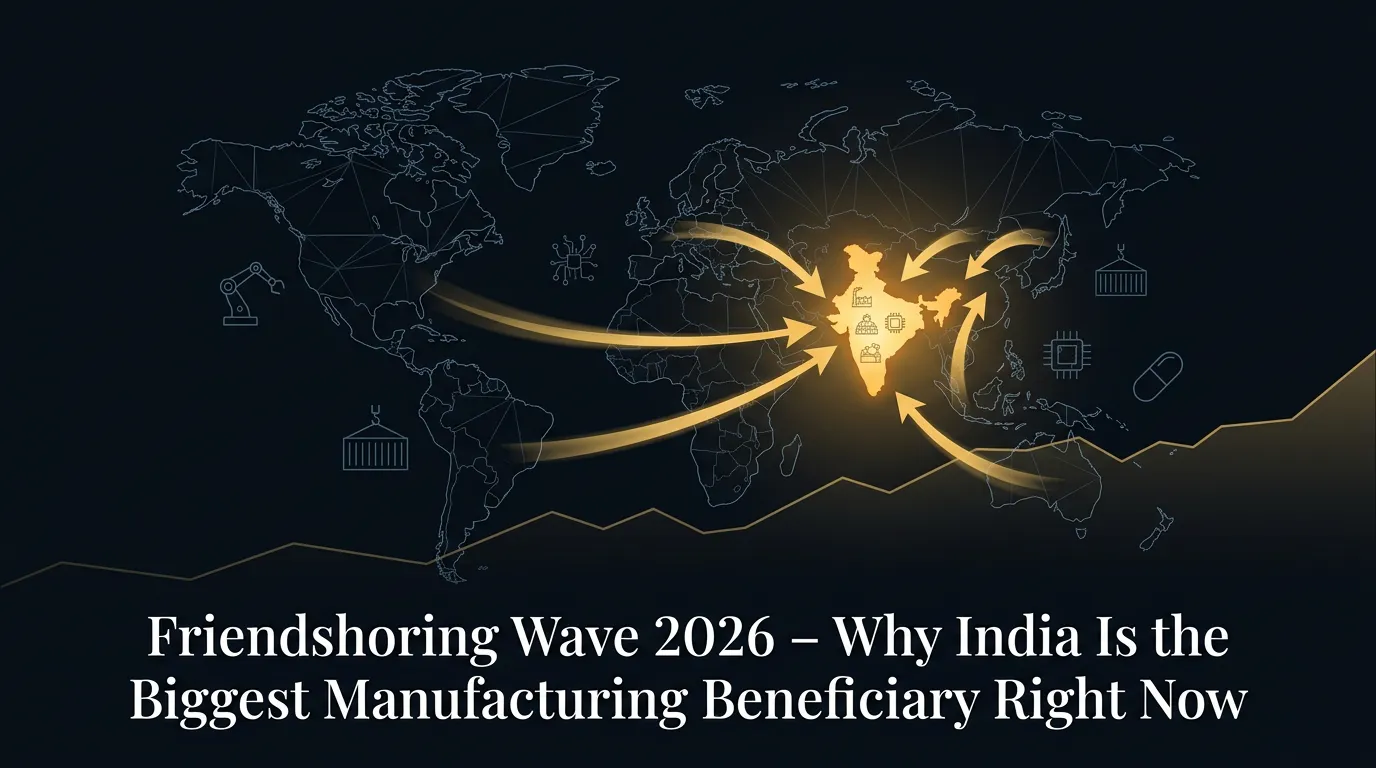
“Friendshoring” - shifting supply chains to geopolitically aligned or neutral countries moved from consulting buzzword to boardroom mandate in 2026. US, EU and Japanese companies are actively reducing China exposure by 25–45 % over the next 36 months (BCG–CNBC March survey).
India is capturing a disproportionate share of that re-shoring wave and the momentum is accelerating.
Hard numbers as of March 2026
- Apple shifted ~18 % of iPhone production to India (Foxconn, Pegatron, Tata).
- Samsung doubled India mobile output to 120 million units/year.
- Micron broke ground on the $2.75 billion Gujarat fab.
- 142 new manufacturing projects worth $38 billion were announced in India in Q1 2026 (Invest India data).
- PLI 2.0 approvals crossed ₹1.8 lakh crore across 14 sectors.
Why India is winning the friendshoring sweepstakes
- Geopolitical neutrality + English advantage — No US ally status required, yet deep English-speaking engineering & management talent.
- Cost + scale combo — Labour cost still 20–35 % of China, but port & highway infra improved dramatically since 2022.
- Government speed — Land allocation, single-window clearance and power subsidy execution is now 4–6× faster than 2020–22.
- China risk premium — Every CFO now adds 15–25 % “China-risk buffer” to sourcing decisions — India no longer needs to be the cheapest; it just needs to be safer and reasonably priced.
Who is moving fastest
- Consumer electronics & semiconductors → Apple, Samsung, Micron, Dixon
- Auto & EV → Tesla (finalising Gujarat plant), BYD (Hyderabad discussions), Hyundai/Kia doubling down
- Defence & aerospace → Lockheed Martin, Boeing, Airbus offsets flowing to Tata, L&T, Bharat Forge
- Pharmaceuticals & chemicals → Pfizer, Novartis expanding API & formulation capacity
Risks to watch
- Skill-gap in advanced manufacturing (only 4.5 % of Indian workforce has formal Industry 4.0 training).
- Power reliability in non-industrial states.
- Water & effluent treatment bottlenecks in high-density clusters.
For Indian manufacturers, ancillary players and state governments: 2026–2029 is likely the strongest capex and order-book cycle since liberalisation. The window to build capacity, train talent and lock long-term contracts is measured in quarters, not years.
Friendshoring isn’t a buzzword anymore; it is India’s biggest manufacturing tailwind since the 1991 reforms. Miss it and you miss the decade.