Gold loans have nearly doubled at four big NBFCs. The first cracks are in repayment schedules
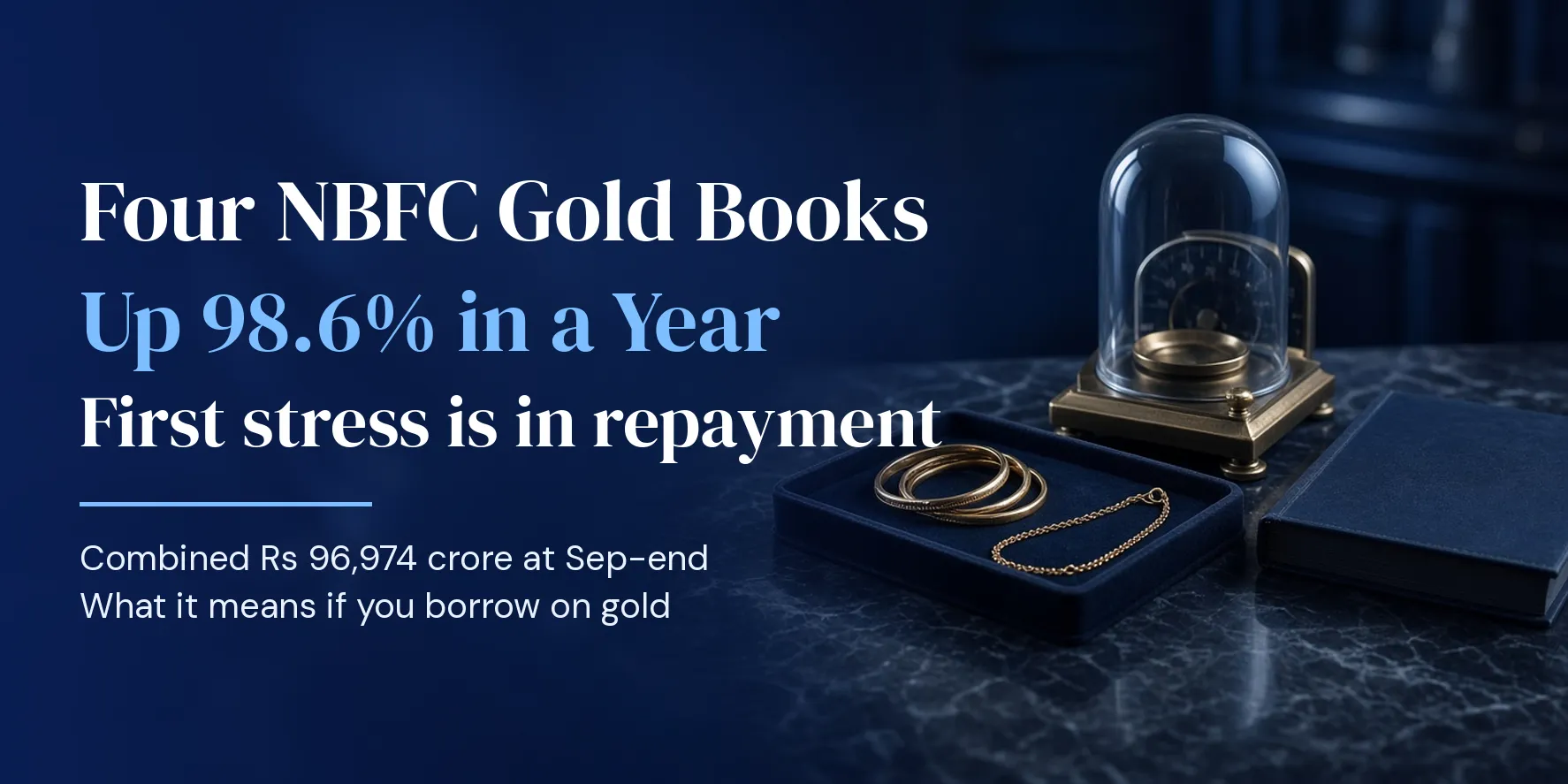
Add up the gold-loan books that Bajaj Finance, HDB Financial, L&T Finance and IIFL Finance reported for 30 September 2026 and the total is Rs 96,974 crore. A year earlier the same four stood at Rs 48,831 crore. That is growth of 98.6%, and it lifts gold from 6.3% of their combined loan books to 10.0% (both calculated from the companies' own presentations and press releases, published 14 to 19 October).
The same results carry the first warning signs. They matter to anyone who has pledged jewellery to fund stock or salaries.
One lender carries most of the doubling
IIFL Finance holds Rs 65,729 crore, up 90% and 52.9% of its book, which is about two-thirds of the four-lender total (calculated). Bajaj Finance reported Rs 24,195 crore, up 105%. L&T Finance went from Rs 1,475 crore to Rs 5,043 crore, and HDB Financial from Rs 990 crore to Rs 2,007 crore, still only 1.6% of its loans (calculated). Shriram Finance, which sits outside that total, reported Rs 8,974 crore, up 68.2%, and its management said on 23 October that the plan to double gold to about 5% of the book stands.
Muthoot Finance and Manappuram Finance, the two largest gold specialists, had no September-quarter results that could be found by 28 October, so this picture leaves them out. IIFL founder Nirmal Jain's comment in the company release opens with "As gold loan growth moderates", before pointing to home and secured business loans as the next source of momentum.
Where the stress shows
At Shriram Finance, gross Stage 3 gold loans (overdue beyond 90 days) rose to 3.12% from 2.28% a year earlier, as relayed in summaries of its results slides; the slides themselves could not be opened for this article. Applied to the whole gold book, that is roughly Rs 280 crore (calculated, illustration). Executive Vice Chairman Umesh Revankar told the 23 October call the cause was the launch of EMI and interest-servicing gold loans, because borrowers were "habituated to servicing only bullet repayment". He added that the company can sell the gold if a loan goes bad, and that EMI borrowers can get a slightly larger loan.
Bajaj Finance tells a related but different story. Its Stage 2 gold loans, overdue 31 to 90 days, stood at Rs 1,099 crore, about 4.5% of the gold book (calculated). Vice Chairman and Managing Director Rajeev Jain attributed this to short-tenor schemes: a borrower had to visit a branch every three months to pay interest or roll over, one missed visit meant delinquency, and the only exit was paying principal and interest in full. Those schemes stopped in August. Rs 550 crore had moved back to Stage 1 by the 19 October call, and 99% of customers were on bullet loans. The company's deck shows only Rs 7 crore of provisions held against that Stage 2 pool.
IIFL's presentation shows 5.2% of its on-book gold loans (Rs 40,499 crore) overdue 31 to 90 days and 0.9% beyond 90, with gold gross NPA at 0.90% against 0.12% a year ago. It gave no commentary on repayment structure in the documents read.
The pattern, then, is not simply an EMI problem. Delay is rising where the repayment pattern changed, to EMI at one lender and to short rollovers at another. The lenders say losses have not followed, because the gold can be sold. None of the figures above is attributed by the companies to a fall in gold prices.
The gold-price half
IBJA's 999-purity rate stayed between about Rs 1.41 lakh and Rs 1.43 lakh per 10 grams from 22 to 28 October, before GST and making charges. On the call, Rajeev Jain said Bajaj still holds a 75% loan-to-value ratio, interest included. He also said the average gold loan runs six to seven months, so the collateral is repriced often.
The arithmetic for one borrower is blunter. Take a Rs 5 lakh loan at 75% LTV, so the gold is worth Rs 6.67 lakh (illustration, calculated):
| Fall in gold price | Gold value | LTV |
|---|---|---|
| 10% | Rs 6.00 lakh | 83.3% |
| 20% | Rs 5.33 lakh | 93.8% |
Accrued interest pushes the ratio higher still. Shriram reported an average of 72% to 73% including interest, and IIFL 70% (basis not stated). What each lender does when the ratio breaches its limit is not in the documents read, so it has to be asked.
What a business owner should do
A gold loan suits a gap with a known end: an invoice due in 60 to 90 days, or festive stock that sells through by December. It suits permanent working capital badly, because renewals keep resetting the interest bill and the gold stays locked up.
Match the repayment shape to the calendar. Daily or weekly takings fit monthly interest servicing; income that lands in one or two large payments fits a bullet. A bullet is simple, but at 18.7% a year (IIFL's average gold yield, not a quote for any borrower) a Rs 5 lakh loan for six months carries about Rs 46,750 of interest due with the principal (illustration, simple interest). Monthly servicing eases that lump but makes every date binding, and Bajaj's Stage 2 experience shows what a missed date can cost. Avoid any scheme that needs a branch visit every few weeks to roll over.
Before signing, get these in writing: the LTV on day one and at maturity with interest included; the LTV at which the lender asks for more gold or payment, and the notice it gives before an auction; what happens to any surplus from a sale; the total cost including valuation, processing and late fees; and the renewal rate. Ask also whether the loan is booked as business or personal, because RBI's published gold-loan directions set the LTV ceilings and the 12-month bullet cap for consumption loans and describe business-purpose loans as a separate category.
Borrow well below the ceiling, and keep other collateral or cash in reserve. The sounder course is to treat the headroom between loan and gold value as part of the real cost of the loan.
This is general information, not CA, legal or financial advice; speak to your CA or a qualified adviser before borrowing against gold.