
Manufacturing Sector Rebounds with Smart Factory Investments
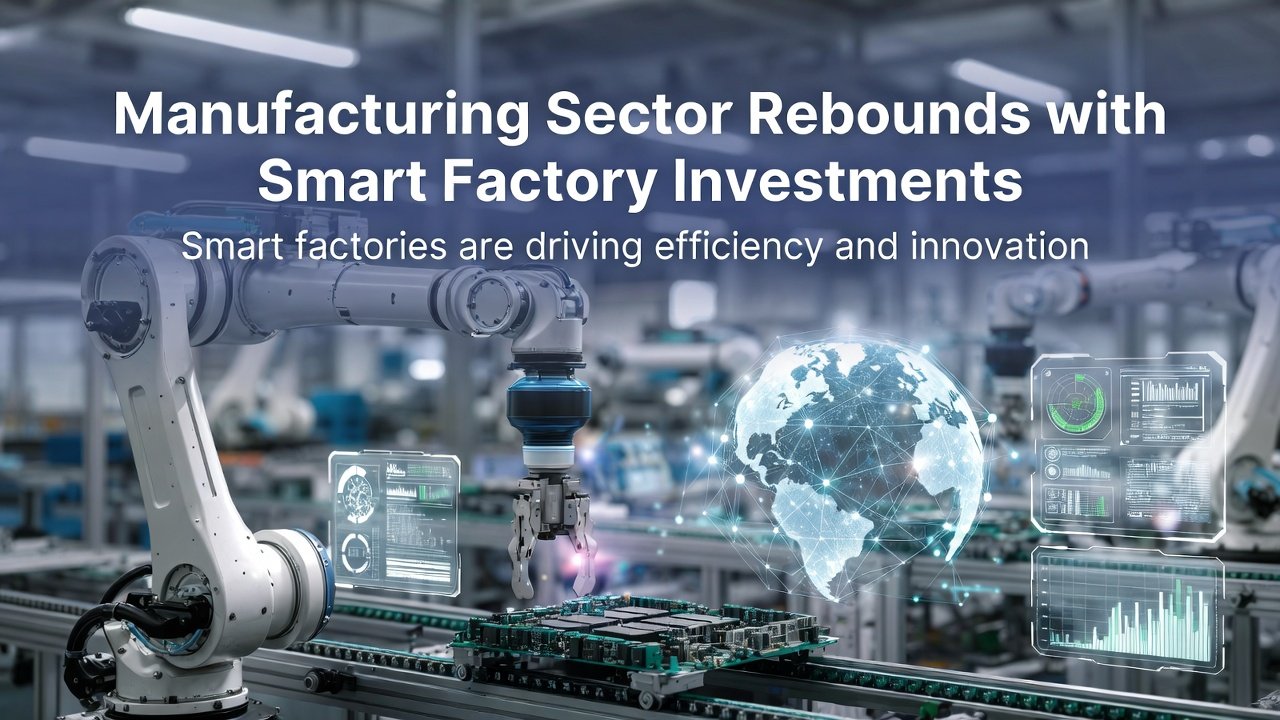
After years of headlines dominated by supply-chain disruptions, geopolitical tensions, and the lingering shadow of the pandemic, India's manufacturing sector is staging a quiet but powerful comeback. The driver? A massive wave of capital pouring into smart factories, automation, and Industry 4.0 infrastructure. What began as experimental pilots in 2022–23 has now matured into full-scale deployment across automotive, electronics, pharmaceuticals, textiles, and heavy engineering. The numbers are telling manufacturing GVA growth accelerated to 7.8% in FY26 (Q3 provisional), the highest quarterly pace since pre-pandemic levels, and private capex announcements in smart manufacturing crossed ₹1.8 lakh crore in calendar 2025 alone.
The phrase “smart factory” is no longer jargon. It describes facilities where machines talk to each other in real time, predictive analytics prevent breakdowns before they occur, digital twins simulate production runs weeks in advance, and AI-driven quality inspection catches defects invisible to the human eye. Leading the charge are large conglomerates and mid-sized champions alike.
Tata Motors’ Pune and Sanand plants have become poster children for the transition. By integrating Siemens Xcelerator and Tata Technologies’ digital-thread platform, the company reduced unplanned downtime by 42% and improved first-pass yield on EV battery trays by 31% within 18 months. Maruti Suzuki, meanwhile, has rolled out cobots and vision-guided robotics across its Gujarat and Haryana lines, targeting a 25% productivity lift by FY27. Even traditional sectors are moving fast: Raymond’s denim facility in Vapi now uses real-time fabric defect detection powered by computer vision, slashing waste by nearly 19%.
What explains the acceleration? Three structural tailwinds are converging.
First, policy firepower. The Production Linked Incentive (PLI) schemes, now covering 14 sectors and ₹1.97 lakh crore in committed outlay have acted as a massive demand signal for automation. The ₹28,602 crore PLI for electronics manufacturing has already attracted commitments for 35 new semiconductor and component units, most of which are being built as “lights-out” or near-lights-out facilities. The recently announced ₹10,000 crore Smart Manufacturing Mission under the Ministry of Heavy Industries provides up to 25% capital subsidy for digital-twin and IIoT deployments, lowering the payback period for many projects from seven years to under four.
Second, cost of capital has become friendlier. Post-2024 RBI rate cuts and the government’s push for long-tenure project finance, term-loan rates for capex in manufacturing have fallen to 8.5–9.75%. Add the availability of ₹50,000 crore in dedicated manufacturing-focused credit lines from SIDBI, PFC, and REC, and the financial math starts to look compelling.
Third and perhaps most decisive is the reshoring and China+1 narrative that refuses to fade. Global OEMs and Tier-1 suppliers continue to diversify away from concentrated risk in East Asia. Apple’s contract manufacturers (Foxconn, Pegatron, Tata Electronics) have expanded Karnataka and Tamil Nadu facilities with heavy automation to meet iPhone 17 series targets. Samsung and Micron are scaling NAND and DRAM packaging lines in Gujarat and Assam with robotic material handling and AI quality gates. The result: India’s share of global electronics manufacturing value added is projected to rise from 3.5% in 2023 to 7–8% by 2030, according to a joint NITI Aayog–McKinsey report released last month.
Yet the rebound is not uniform. While large players with balance-sheet strength and global linkages are racing ahead, MSMEs remain the weak link. A FICCI–CII survey from December 2025 found that only 18% of firms with turnover below ₹250 crore have implemented any form of Industry 4.0 technology, compared with 67% for firms above ₹1,000 crore. The principal barriers cited are high upfront capex, lack of skilled talent (especially in OT-IT convergence), and cybersecurity concerns.
The government is attempting to bridge this divide. The recently launched ₹5,000 crore MSME Digitalisation Fund offers concessional loans and grants for ERP, MES, and basic IIoT adoption. Industry bodies are stepping up too: CII’s Smart Factory Accelerator Program has trained over 4,200 shop-floor supervisors and engineers in the past 18 months, while NASSCOM’s FutureSkills Prime platform now offers short modular courses in industrial IoT and cyber-physical systems.
Looking ahead, 2026–28 will be the make-or-break window. If India can scale smart-factory adoption beyond the top 200–300 companies to the broader 1.5 lakh+ formal manufacturing units, the productivity multiplier could push overall manufacturing GVA growth toward double digits for a sustained period. That would be transformative, not just for factory gates, but for employment, exports, and India’s position in global value chains.
For now, the renaissance is real. Machines are no longer dumb tools; they are thinking partners. And Indian manufacturing, long written off as a sunset story, is proving it still has plenty of sunrise left.