
MedTech Consolidation: Building Global-Scale Capabilities Prime Business Navigator | February 2026
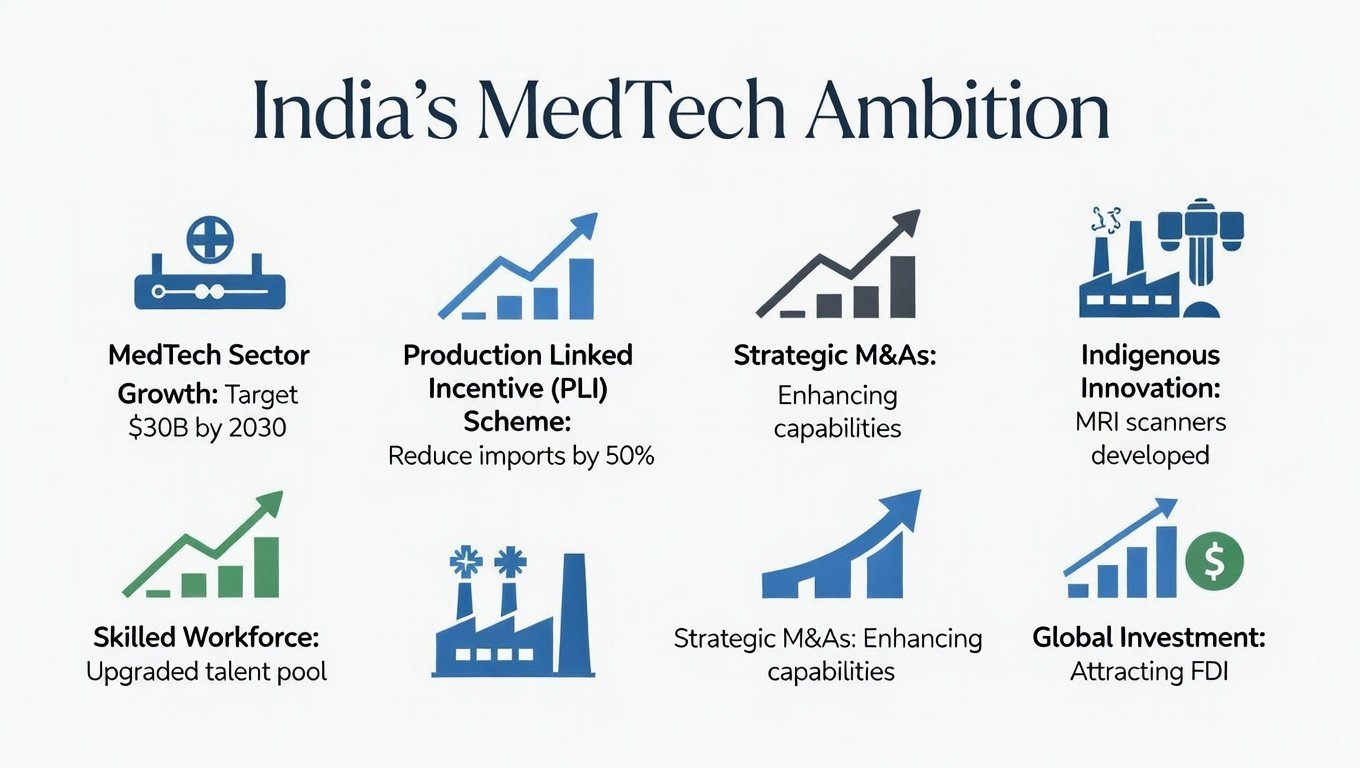
By the end of the decade India’s medical technology industry is widely expected to touch $30–32 billion in annual revenue, a number that would place the country among the top five MedTech markets globally. Yet the real story of 2026 is not the headline figure; it is the structural transformation taking place behind it. After years of fragmented growth dominated by imports and small-scale domestic manufacturing, the sector is entering a decisive consolidation phase. Large players are acquiring promising startups, global contract manufacturers are deepening their Indian footprint, and the government’s Production Linked Incentive (PLI) scheme is quietly forcing a re-write of supply-chain economics.
The PLI-MedTech scheme, launched in 2020 with an outlay of ₹3,420 crore, has so far disbursed incentives to 13 winning applicants and attracted committed investments of roughly ₹4,000 crore. The most visible outcome is the sharp reduction in import dependence. Industry estimates now place domestic value addition in select high-priority categories- surgical instruments, diagnostic imaging equipment, patient-monitoring devices at 45–55% higher than pre-PLI levels. For context, India still imported nearly 80–85% of its advanced medical devices in 2019; the target is to bring that ratio down to 50% or lower by 2030. Early data from the Department for Promotion of Industry and Internal Trade (DPIIT) suggests the trajectory is on track.
Consolidation is the mechanism delivering this shift. In the past eighteen months alone, at least seven noteworthy transactions have reshaped the competitive landscape:
- Trivitron Healthcare acquired majority stakes in two imaging startups, strengthening its position in cardiac and oncology diagnostics.
- Poly Medicure (Polymed), already India’s largest listed MedTech company by revenue, purchased a controlling interest in a Gujarat-based infusion-therapy manufacturer, extending its vertical integration.
- Global major B. Braun entered a joint venture with an Indian orthopaedic-implant maker, combining European design expertise with local manufacturing scale.
- Most symbolically, Bengaluru-based Voxelgrids Innovations successfully installed its first fully indigenous 1.5T MRI scanner at a tier-2 government hospital in Karnataka in late 2025, a machine that competes on both image quality and price with mid-range imports from GE, Siemens, and Philips.
These deals are not opportunistic bolt-ons; they are deliberate attempts to build end-to-end capabilities. A typical pre-PLI Indian MedTech firm might have excelled in low-to-mid technology products (disposables, basic monitors) but lacked the capital, regulatory expertise, or global distribution to move upstream into capital equipment. Today’s acquirers are purchasing exactly those missing pieces: proprietary algorithms, FDA/CE-compliant design dossiers, and established clinician networks.
The supply-chain benefits are already measurable. Lead times for critical components, printed circuit boards for ventilators, rare-earth magnets for MRI gradients, precision-moulded cannulas have fallen from 90–120 days to 30–45 days in several clusters (Noida, Ahmedabad, Chennai). Local sourcing has also insulated companies from the currency and freight volatility that plagued the sector during 2022–24. One large Chennai-based manufacturer reported a 22% reduction in bill-of-materials cost after switching 60% of its semiconductor and polymer inputs to Indian Tier-1 and Tier-2 suppliers nurtured under the PLI umbrella.
Yet consolidation is not without friction. The most persistent headwind remains talent. India produces roughly 1.5 million engineering graduates annually, but only a small fraction have hands-on experience in medical-grade design controls, ISO 13485 quality systems, or risk-management protocols mandated by global regulators. The gap is widest in software verification & validation, electromagnetic compatibility testing, and clinical-data management; skills essential for Class IIb and Class III devices.
The government is responding. The National Institute of Pharmaceutical Education and Research (NIPER) network has added dedicated MedTech centres in Mohali, Hyderabad, and Guwahati, each equipped with Class-7 and Class-8 cleanrooms, MRI/CT phantoms, and simulation labs. Industry-academia consortia, such as the IIT Madras-led Biomedical Devices Innovation Hub and the IIT Delhi-Tata Trusts collaboration are now graduating 400–500 engineers a year who are job-ready for design-to-manufacturing roles. Private players are also stepping up: Trivitron and Skanray have launched internal academies that train 200–300 engineers annually, while global firms such as Medtronic and GE HealthCare have expanded their Bengaluru R&D centres to 1,800+ employees.
For investors, the consolidation wave creates a clear set of opportunities. First, mid-cap listed companies with strong balance sheets (Polymed, Trivitron, Opto Circuits) are likely to be serial acquirers over the next three years, offering both organic growth and inorganic accretion. Second, select unlisted high-technology startups, particularly those in digital pathology, AI-assisted radiology, and wearable diagnostics are attracting strategic interest from both Indian conglomerates and global MedTech giants seeking an Indian manufacturing base. Third, the ancillary ecosystem (precision machining, injection moulding, sterilization services) remains under-penetrated and ripe for private-equity roll-ups.
The bigger picture is even more compelling. If India achieves the $30 billion milestone by 2030 and most credible forecasts now place the probability above 70%, the country will not merely become a large market; it will emerge as a credible global manufacturing hub for mid-technology and selected high-technology devices. That transition is no longer aspirational. It is under way, powered by policy tailwinds, capital discipline, and the hard logic of consolidation.
The next three years will decide whether Indian MedTech consolidates into a handful of globally competitive champions or fragments again under competitive pressure. Early evidence from Voxelgrids’ MRI milestone to Polymed’s latest acquisition suggests the former outcome is distinctly within reach.