
S&P and Fitch Raise India’s Growth Forecast for FY27
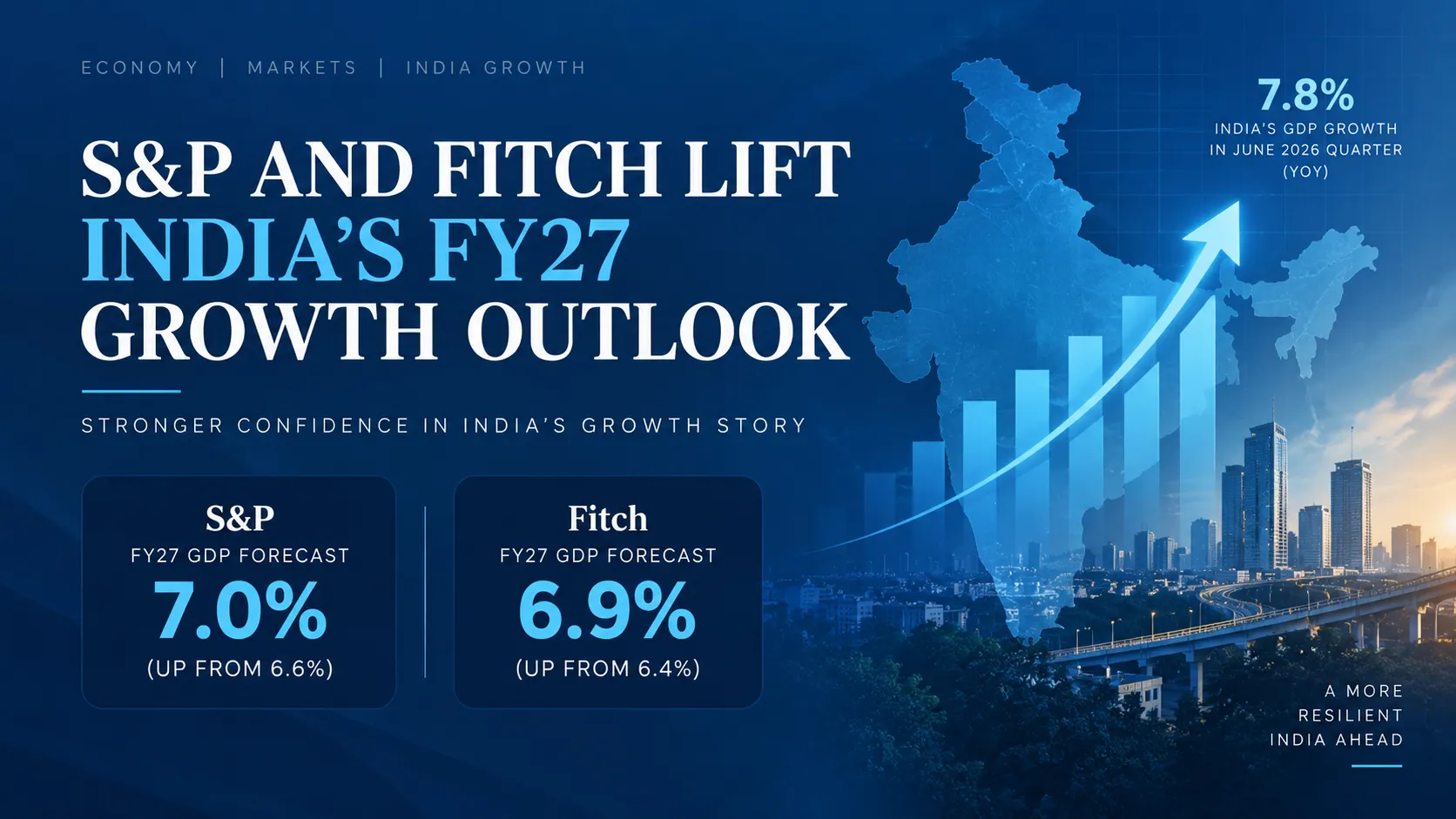
On 23 September 2026 two of the world’s main rating houses moved India’s growth numbers up on the same morning. S&P Global Ratings raised its forecast for the fiscal year ending 31 March 2027 to 7 percent from 6.6 percent. Fitch Ratings lifted its own call to 6.9 percent from 6.4 percent. The trigger was the same set of books. India’s economy grew 7.8 percent in the June quarter, faster than both firms had built into their earlier models.
S&P put the extra speed down to factories, shoppers, goods exports and public investment. In its Economic Outlook Asia Pacific report the firm said industrial activity was robust, consumption was healthy, merchandise exports were strong and government investment was accelerating. Those four engines, it said, pushed growth above what it had expected for the quarter. The agency now sees consumer inflation averaging 5.1 percent in FY27. It also said the balance of policy is shifting toward higher interest rates. Solid growth, sticky prices, an unresolved conflict in West Asia and a weak monsoon all argue, in S&P’s view, for the Reserve Bank of India to raise the policy rate by 25 basis points this fiscal year, taking it to 5.5 percent from 5.25 percent.
Fitch told a similar story with a slightly lower ceiling. It said growth in India remains very strong and that the economy has shown resilience after the oil shock from the US and Iran war, even as the terms of trade worsened in the first half of 2026. Fitch now puts FY26 growth at 7.8 percent, up from 7.4 percent in its June outlook. For FY27 it expects investment to rise by more than 10 percent and notes that non food credit was running at about 19 percent in July. Private investment, it said, looks more buoyant than it did a quarter ago.
Both houses also wrote the second half of the year in a quieter tone. S&P said growth could ease as the lift from Goods and Services Tax changes and income tax cuts fades. Fitch said manufacturing and services surveys already point to a slower pace, and that below normal monsoon rain could weigh on farms and rural demand. Cumulative rainfall was about 15 percent below normal till 9 September 2026, a figure S&P flagged as a watchpoint for food prices. Fitch expects headline inflation near 5.5 percent by December and then a gradual retreat toward the RBI’s target later in 2027.
The rate path is where the two notes diverge in timing, not in direction. Fitch is more precise. It expects a 25 basis point rise in October to 5.5 percent, another step to 5.75 percent in early 2027, and then an easing back to 5.5 percent in 2028. S&P spreads the first 25 basis points across the current fiscal year and then holds the rate at 5.5 percent through FY29 in its published path. The RBI’s own FY27 growth number sits lower, near 6.7 percent after the August review. Moody’s and the Asian Development Bank have also moved toward 7 percent, so the cluster of official and private forecasts is now tighter than it was in June.
For Indian business the message is not a victory lap. It is a picture of an economy that grew through an energy shock and is now running hot enough that lenders and the central bank may have to lean against prices. Factories, exporters and the government’s capex pipeline are doing the heavy lifting. Food and fuel remain the soft spots. The rupee has also lost more than 5 percent against the dollar through mid September, another reason S&P says imported costs cannot be ignored.
The upgrades do not change the next MPC calendar by themselves. They do change the conversation around it. When two large rating firms raise growth and still pencil in a rate rise on the same day, they are saying demand is strong enough to absorb tighter money. Whether the RBI agrees in October will depend on the next inflation print and on how the monsoon finishes. Until then the September 23 notes stand as the clearest external verdict so far this month. India’s FY27 expansion is being written closer to 7 percent, and the cost of that speed may be a higher policy rate.