
BRICS Leaders Meet in New Delhi to Talk Payments and Supply Chains
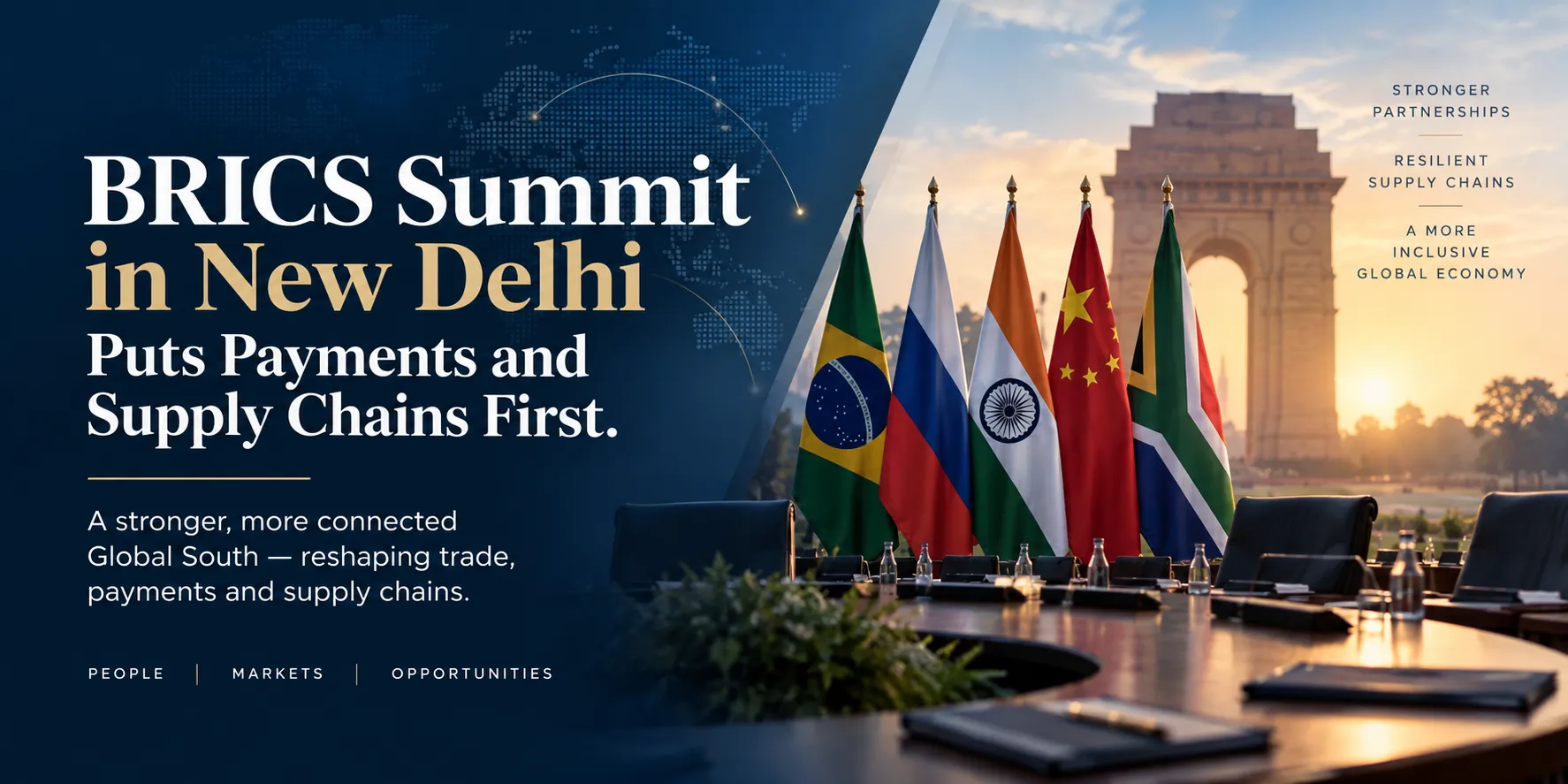
The 18th BRICS Summit opened in New Delhi on 12 and 13 September 2026 at Bharat Mandapam with a practical question hanging over the hall. How do large emerging economies keep trade moving when shipping routes are strained, payments remain costly, and supply chains keep snapping. India, holding the chair for the fourth time, has tried to keep the answer close to business rather than theatre.
The grouping now has 11 members: Brazil, Russia, India, China, South Africa, Egypt, Ethiopia, Indonesia, Iran, Saudi Arabia and the United Arab Emirates. Together they account for about half the world’s population and a large share of global output and trade. Leaders arriving for the two-day meeting include Chinese President Xi Jinping, on his first visit to India in seven years, Russian President Vladimir Putin, Iranian President Masoud Pezeshkian, South African President Cyril Ramaphosa and Indonesian President Prabowo Subianto. The UAE is represented at a senior level. The closed session is themed Inclusive Global Governance and Strengthening Multilateralism. The open session is titled Resilience, Innovation, Cooperation and Sustainability: Shaping the Future for Inclusive Global Growth. The meeting is expected to end with a New Delhi Declaration.
What India has put at the centre is not a new flag or a new currency. It is the plumbing of trade. Commerce and Industry Minister Piyush Goyal told the BRICS Business Forum on 11 September that member and partner countries should link payment systems, settle more business in local currencies and simplify rules so goods and services can move with less friction. He pointed to India’s Unified Payments Interface, which handles more than 250 billion transactions a year and is already accepted in 11 countries. The pitch was simple. If digital rails can travel, trade inside the bloc does not have to wait on slow correspondent banking.
Finance ministers and central bank governors meeting in Mumbai on 10 September gave that idea official language. Their joint statement said the BRICS Payment Task Force should keep studying how payment and messaging systems can talk to one another and how local currencies can be used for trade and investment. There is, they added, no one-size-fits-all model. The goal they named is payments that are fast, low-cost, accessible, efficient, transparent and safe.
That is the line New Delhi has drawn with care. India does not support a common BRICS currency. It also does not want a single bloc-wide settlement network that would look like a rival to SWIFT. Officials familiar with the talks say Prime Minister Narendra Modi favours linking national central bank digital currencies so two countries can settle trade without converting everything into a third currency. India already runs a digital rupee pilot. China and Russia have been testing their own digital currencies. Brazil has Pix. Russia has SPFS. China has CIPS and the digital yuan. The Indian idea is to connect what already exists rather than invent a new money.
The commercial case is already visible in pieces. Around 96 percent of India’s trade with Russia now moves through rupee-ruble arrangements, according to Sberbank’s India head. Almost all trade between Russia and China is settled in yuan and rubles. India also has local-currency settlement arrangements with the UAE, Indonesia, Maldives and Mauritius. RBI Governor Sanjay Malhotra has said cross-border payments interest every BRICS member because costs can still be cut. Linking fast-payment systems and CBDCs is one way to do that without asking firms to wait days for a dollar clearance.
Supply chains sit beside payments on the same table. Under India’s chairship the trade track adopted a 2026 to 2030 Global Value Chains Action Plan, along with a logistics and supply-chain cooperation framework. Ministers also approved work on MSMEs, including the Jaipur Consensus and a study of a BRICS invoice discounting mechanism so smaller exporters can get paid faster. Members gave in-principle approval to a customs cooperation agreement. The point is not a slogan about resilience. It is to give factories, shippers and small firms more than one route when a corridor closes.
The summit arrives in a hard year. Conflicts in West Asia and Ukraine, strained sea lanes and a more fragmented trading system have made it costlier to move goods and settle invoices. An expanded BRICS is not of one mind on every political dispute. Earlier this year foreign ministers could not issue a joint statement and India put out a chair’s text instead. That is why New Delhi has tried to park the loudest fights and keep the leaders on payments, logistics, technology, health and climate, where interests overlap even when capitals do not.
For companies watching from outside the hall the test is whether any of this leaves the communique. Linking UPI-style systems, allowing more rupee, yuan, ruble or dirham settlement, and standing up a logistics framework would not replace the dollar tomorrow. It would give traders inside the bloc a cheaper second option. That is the modest bet India is placing as host. The photographs will show the handshakes. The business story is whether money and goods can move a little faster when the usual rails are crowded.