WTO Says Global Trade Rules Stand at a Critical Juncture
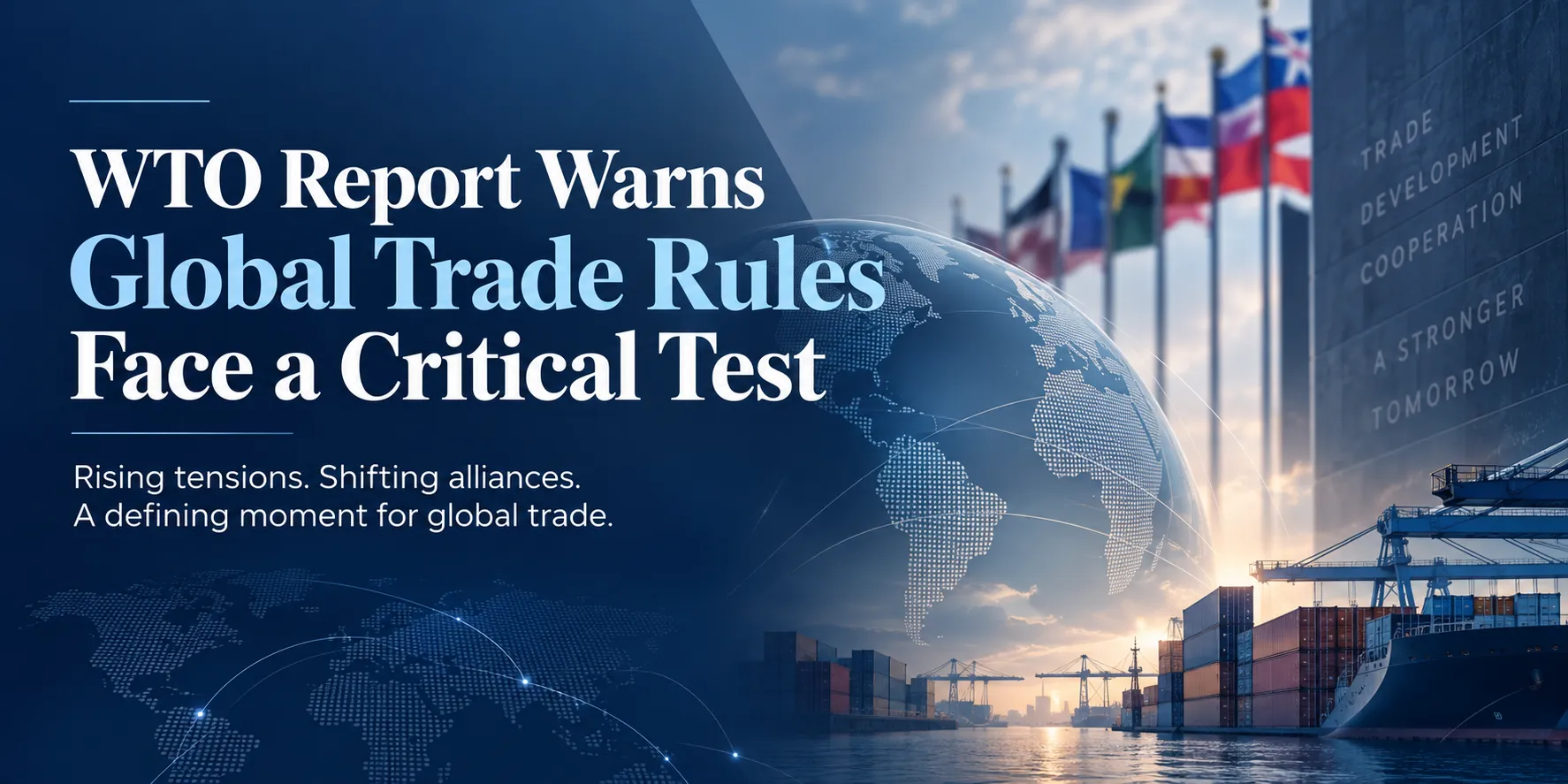
On 15 September 2026 the World Trade Organization published its flagship World Trade Report and gave members a blunt choice. Update the common rulebook or watch it fray. The title of the study is A Critical Juncture for the World Trading System. The numbers behind that title are large enough to matter to any firm that ships, sources or sells across borders.
A strengthened multilateral framework, the economists say, could raise global GDP by 2.9 percent and global exports by 17.9 percent by 2050 compared with the path the world is on now. In money terms that is about 3 trillion dollars of extra output. Least developed countries, which still account for less than 1 percent of world trade, could see their GDP rise by 7.7 percent if tariffs and other trade costs fall. High income economies would capture a large share of the absolute gain, about 1.7 trillion dollars in 2023 dollars, much of it from cheaper trade in services.
The other two futures in the report are darker. In a geo fragmented world, where commerce is organised around political blocs, global GDP would be 5.1 percent lower and exports 18.6 percent lower by 2050. In a free trade agreement world, where common WTO cooperation fades and is replaced by a patchwork of separate deals, GDP would fall 6.9 percent and exports 26.9 percent. The gap between the best and worst of those paths is close to 10 percent of global output. That is the figure Director General Ngozi Okonjo Iweala used when she said inaction to modernise the system could reduce world output by as much as 10 percent.
She also reminded members that the old system has not vanished. Around 72 percent of global merchandise trade still moves under the WTO’s most favoured nation terms. Over 80 years, she said, that framework helped build a more integrated economy, narrowed some income gaps and supported peace among members. The unease now, she added in the foreword, comes from a widespread sense that the rules have not kept pace with a rapidly changing world economy.
Chief Economist Rob Staiger told Reuters the system is at a critical juncture. The report names four pressures. Economic power is more widely spread. Low and middle income economies’ share of global merchandise trade has nearly doubled since 1995 and now stands near 45 percent. Bargains struck in the 1990s no longer fit every capital the same way. Governments also intervene more in their own markets, through industrial policy and state support, and existing remedies do not always settle those clashes. Trade itself has changed. Value chains, digital commerce, artificial intelligence and climate policy create effects that jump borders in ways the original WTO texts were not written to handle. Rising political tension has made interdependence look less like a gain and more like a risk.
Those four forces explain why reform talks keep stalling. The WTO has 166 members and works by consensus. They failed to agree a reform package at the ministerial meeting in Yaounde in March 2026 and later reopened talks in Geneva on decision making, dispute settlement, subsidies and the role of the state. Members sit at different stages of development and often want different things from the same rule.
Staiger’s warning is practical. The rules are already under strain and that strain shows up in costs. If cooperation at the global level fell apart, the modelled losses would be large, and smaller and poorer economies would lose more than rich ones. Regional deals can fill some gaps. They cannot, on the report’s arithmetic, replace a common floor of non discrimination and predictability.
For business the message is less about Geneva procedure and more about the price of uncertainty. When the same good faces one set of terms in a bloc and another set outside it, firms spend more on routing, compliance and inventory. When services and digital flows lack shared rules, contracts take longer and disputes travel further. The report’s preferred path is not a return to 1995. It is an updated bargain that still keeps most trade on common terms.
Okonjo Iweala put the choice in one sentence. Members are not choosing between reform and standing still. They are choosing between adapting rules based cooperation to today’s economy and sliding toward a more unpredictable, power based way of managing trade. Most economies, the numbers say, would be worse off if they take the second road. The September report leaves that calculation on the table. What members do with it will decide how expensive the next two decades of trade become.