
Cockroach Janata Party: How a CJI Comment Sparked Agitation That Is Rapidly Losing Steam
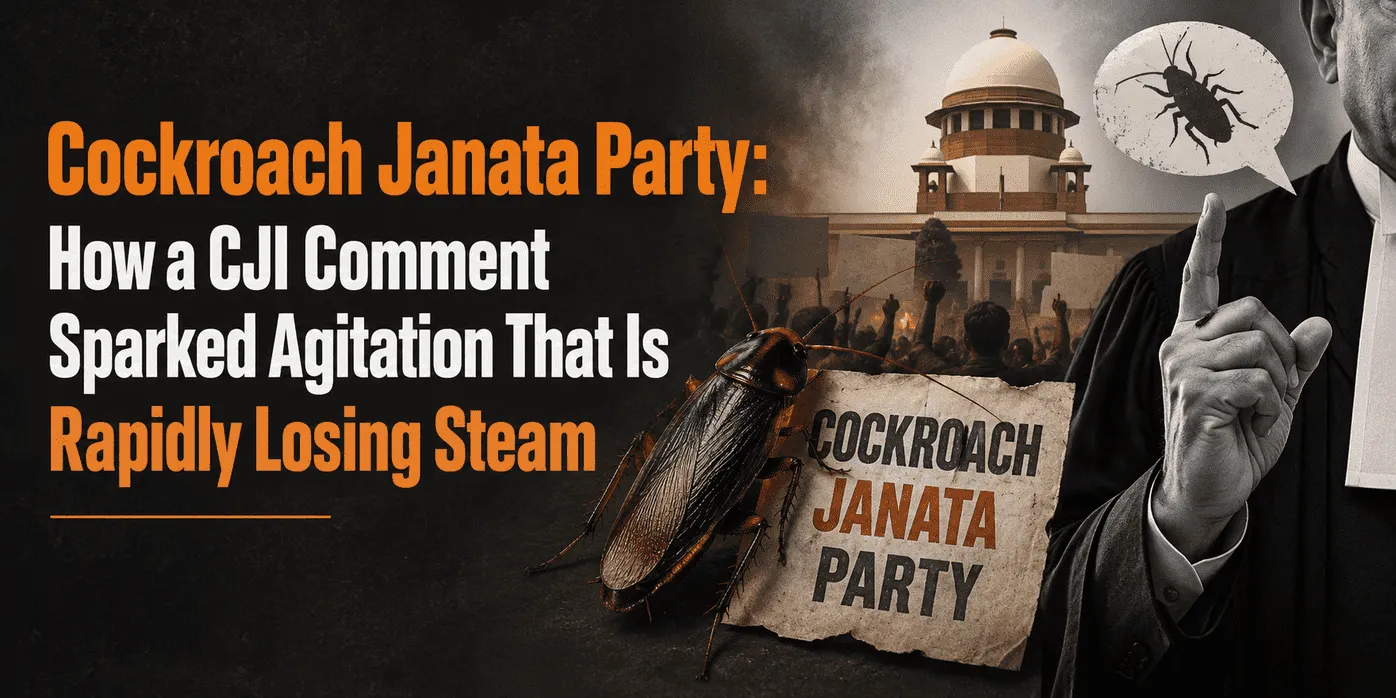
In mid-May 2026, a single remark by Chief Justice of India Surya Kant during a Supreme Court hearing triggered one of the most unusual digital movements in recent Indian political history. What began as widespread outrage among young Indians has morphed into the “Cockroach Janata Party” (CJP)- a satirical, largely online phenomenon that briefly captured national attention but now appears to be losing direction and momentum.
For businesses, investors, and policymakers, this episode offers important signals about youth frustration, digital virality, and the challenges of channeling discontent into constructive outcomes.
The Spark: CJI’s Controversial Remark
On May 15, 2026, while hearing a case involving senior advocate designations, CJI Surya Kant made observations about certain unemployed youth who, according to him, turn to social media, journalism, RTI activism, and criticism of institutions after failing to secure stable employment. He likened them to “cockroaches” and “parasites of society.”
The remarks were widely interpreted as an attack on India’s youth. The backlash was swift and intense. Within 24 hours, 30-year-old Abhijeet Dipke, a public relations graduate, launched the Cockroach Janata Party as a satirical protest. The movement quickly gained millions of followers on Instagram, surpassing several established political parties in digital reach.
CJI Kant later clarified that his comments were aimed at individuals entering professions with fraudulent degrees, not the youth at large, whom he described as “pillars of a developed India.” However, the clarification did little to stem the initial wave of anger.
From Sharp Agitation to Anti-Government Movement
The early phase of CJP was marked by genuine frustration over structural issues:
- High graduate unemployment (reportedly around 40% in some segments)
- Persistent challenges in competitive exams (NEET leaks, etc.)
- Perceived institutional disconnect with young aspirations
The movement adopted a manifesto demanding world-class education, healthcare, clean air, and merit-based opportunities while rejecting “freebie” culture in favor of productivity-focused policies. Opposition figures like Mahua Moitra and Kirti Azad publicly extended support, giving it a political tint.
What started as a youth-led satirical pushback soon evolved into a broader anti-establishment narrative, with some factions directing ire primarily at the central government.
The Turning Point: Loss of Focus and Momentum
Less than a week later, clear signs of dilution have emerged:
- Distraction through Memes and Virality: The movement has largely remained online, dominated by humorous content, cockroach costumes, and symbolic protests (such as cleaning drives). While entertaining, this has shifted focus away from policy depth.
- Internal Contradictions: Mixed messaging between satire and serious political ambition has confused its audience.
- Platform Challenges: Reports of the movement’s X (Twitter) account being withheld in India have limited its reach.
- Co-option Risks: Quick embrace by established opposition voices has made it appear less like a neutral Gen-Z initiative and more like another opposition tool, potentially alienating moderate supporters.
As a result, the initial explosive growth has slowed. What had the potential to become a sustained youth platform for demanding better governance, jobs, and education reform is at risk of fizzling into another short-lived internet trend.
The Bigger Picture: From Protest to Progress?
The Cockroach Janata Party phenomenon reveals a generation that is digitally empowered, quick to mobilize, and unwilling to accept condescending institutional language. However, its rapid loss of focus also demonstrates the limitations of satire-driven movements in delivering tangible change.
For sustainable impact, such energy needs clear leadership, structured demands, and engagement with institutions rather than pure confrontation. The government, judiciary, and corporate sector must respond with substantive actions on employment generation, education reform, and honest dialogue with young Indians.
We believe India’s demographic dividend remains its greatest asset but only if frustration is converted into productive ambition. The fate of movements like CJP will ultimately depend on whether they evolve from viral outrage into constructive forces for economic and social reform.