
Goyal Sits With Industry to Make Trade Rules and FTAs Easier to Use
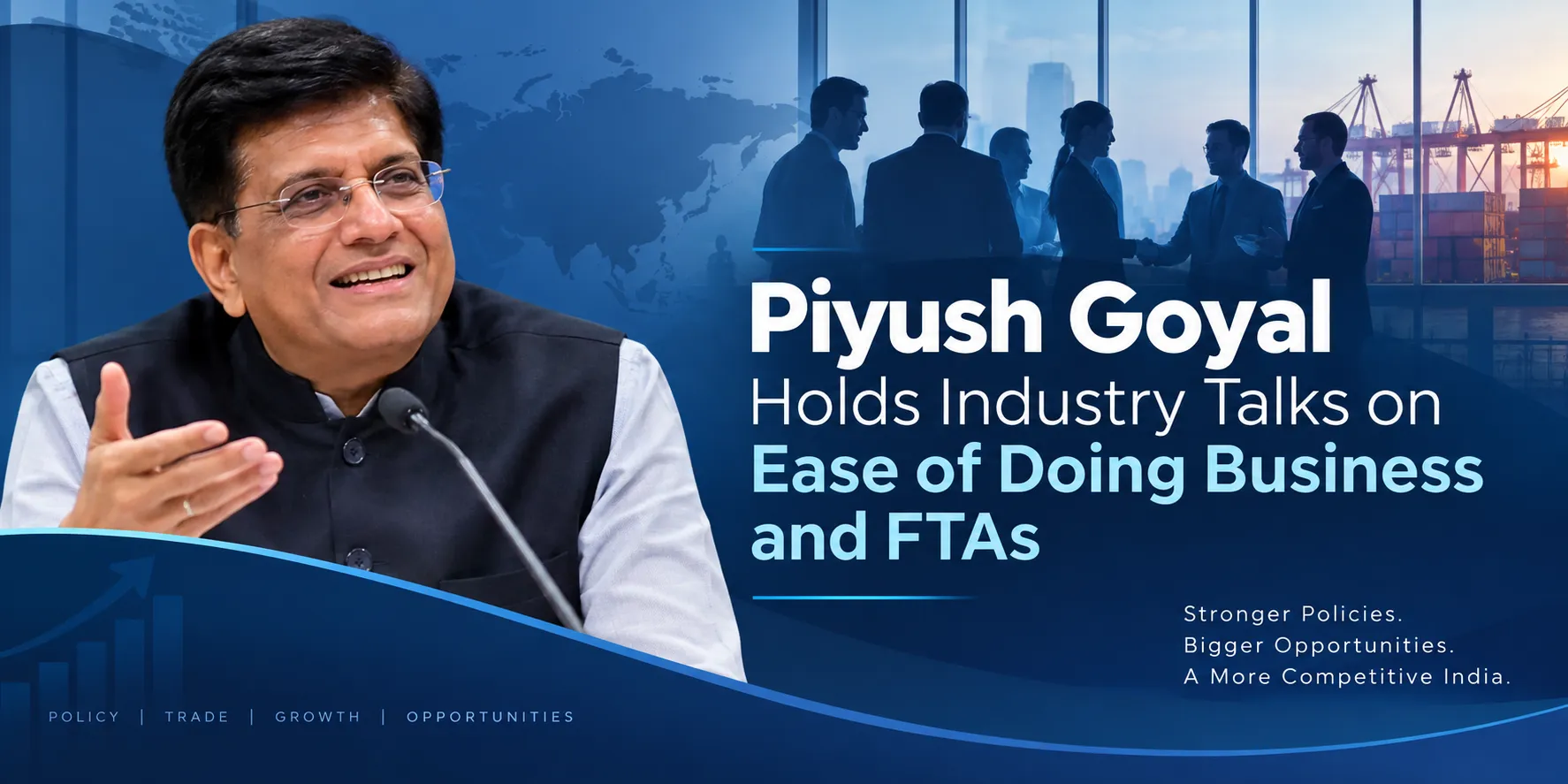
On 22 September 2026 Commerce and Industry Minister Piyush Goyal spent a working day at Bharat Mandapam in New Delhi listening to the people who actually ship goods. The Department for Promotion of Industry and Internal Trade had called a stakeholder workshop on ease of doing business, Free Trade Agreement openings and trade reforms. Minister of State Jitin Prasada sat with him. The room mixed pharmaceuticals, textiles, man made fibres, copper, automotive and engineering firms, air conditioner makers, logistics players, MSMEs and women entrepreneurs. The point was not another speech about policy. It was to hear where the paperwork still sticks.
Goyal’s answer had three parts. First, he said India will not plant a separate office of every department in every city. Instead, integrated Commerce and Industry offices are planned in major cities so a firm can meet several agencies at one desk. Second, he announced a network of about 1,000 trained local people who speak regional languages and will sit with exporters and would be exporters at the district and state level. They are to work through industry chambers and regional associations, not only through a portal in the capital. Third, he previewed Trade Connect, a platform being built to give exporters product wise and HSN code wise facts on destination country tariffs, FTA openings and the steps to claim those benefits, using digital and AI tools.
The FTA session was the other half of the day. India already has pacts in force with the United Kingdom, Oman, the EFTA group, Australia and the UAE. A pact with New Zealand is due to start next month. An India and EU agreement is expected to be signed by December. Industry did not argue against the pacts. It asked for the pipes to work. Firms wanted government systems and foreign trade platforms to talk to each other, including digital sending and checking of Certificates of Origin. They asked that such electronic steps be extended to more FTA partners. They also wanted the export cycle that runs through the Directorate General of Foreign Trade, Customs, banks and other offices to act as one chain rather than four queues. Officials said those ideas would be examined.
One regional industry group got a first formal hearing at this kind of meeting. Makers of roller chains and industrial components said Quality Control Orders, Minimum Import Price rules and higher import duties had changed their market. They reported a 15 fold expansion, about Rs 500 crore in fresh investment and around 5,000 new jobs. The ministry recorded that as proof that standards and duty policy can build capacity at home when they are applied with care.
The rest of the discussion stayed close to the factory floor. People raised trade documents, logistics, how much of an FTA is actually used, domestic supply chains, standards, testing labs and the need for rules that do not shift without notice. Goyal told officials to look at several of those points. Earlier in September he had already told a national FTA outreach workshop that benefits should reach every district, MSME, trader, entrepreneur, startup and woman entrepreneur. Tuesday’s meeting was the next step in that line. Awareness without a local person who can fill a form in the local language does not move a container.
For Indian business the story is practical. Pacts signed in distant capitals mean little if a small exporter cannot prove origin or wait weeks for a bank and Customs to align. A single city office, a thousand trained helpers and a platform that shows tariffs by product code will not rewrite global trade. They can cut the distance between a factory in a district and a buyer who already sits inside an FTA. That is the test Goyal set at Bharat Mandapam. Industry brought the bottlenecks. The government put names on the next tools. The work now is whether those tools show up where the shipments start.