
Semiconductor Mission Accelerates: Cabinet Approvals and DRDO’s New Financial Powers
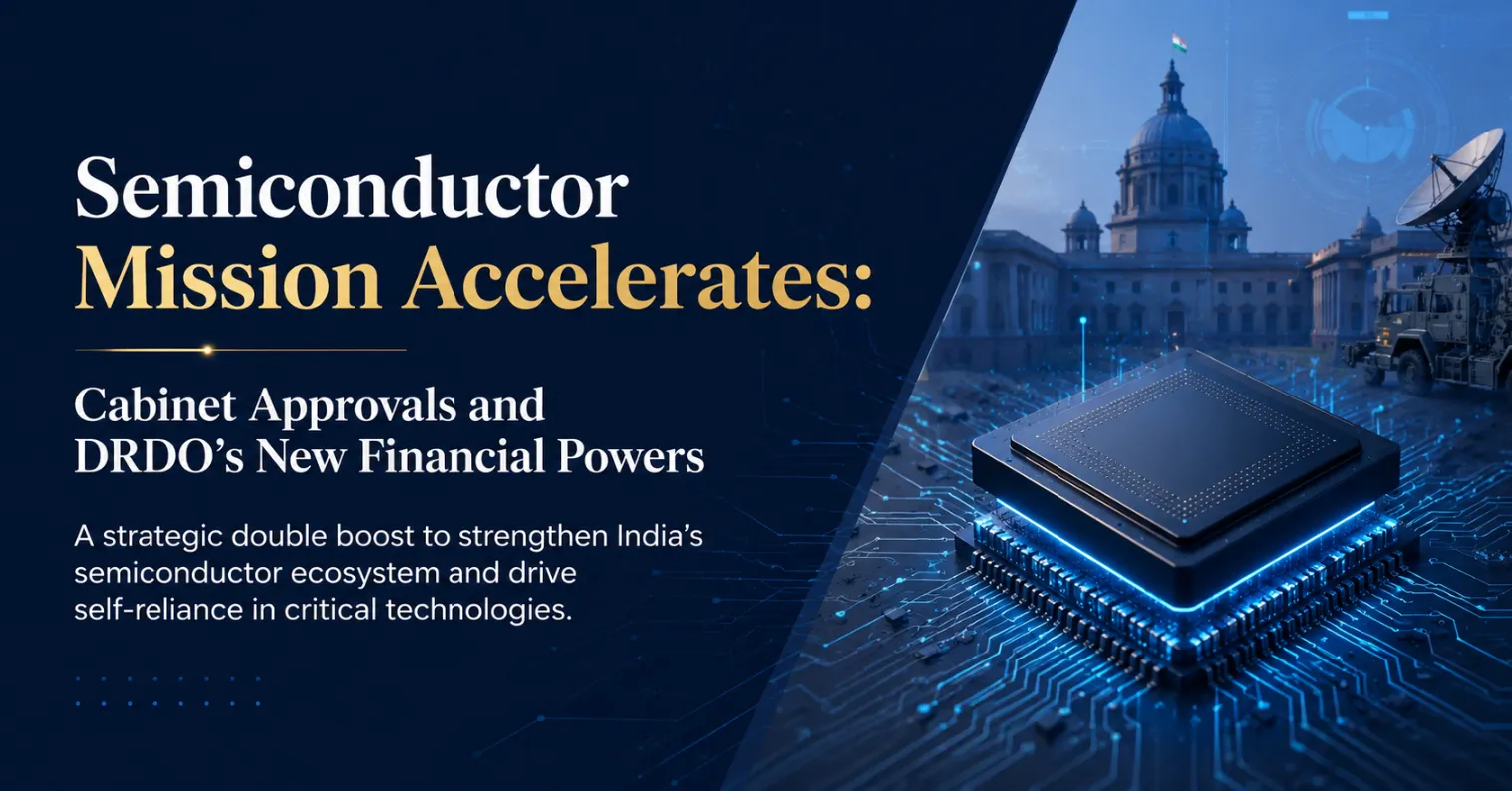
India’s semiconductor journey is hitting a strong stride. In a decisive push this month, the Union Cabinet has greenlit two new projects under the India Semiconductor Mission (ISM), while Defence Minister Rajnath Singh unveiled the Delegation of Financial Powers (DFP-2026) for DRDO. These moves are not just policy tweaks, they are strategic accelerators designed to reduce import dependence, strengthen supply chain resilience, and position India as a serious player in the global semiconductor and defence technology arena.
Cabinet Greenlights Key Semiconductor Projects
On the manufacturing front, the Cabinet approved two significant initiatives with a combined investment of over ₹3,936 crore, expected to generate around 2,230 skilled jobs.
- Crystal Matrix Limited (CML) will set up an integrated compound semiconductor fabrication and ATMP (Assembly, Testing, Marking, and Packaging) facility in Dholera, Gujarat. This includes India’s first commercial Mini/Micro-LED display facility based on Gallium Nitride (GaN) technology. It will focus on epitaxy on 6-inch wafers and support applications in high-performance displays, power electronics, and more.
- Suchi Semicon Private Limited (SSPL) is establishing an Outsourced Semiconductor Assembly and Test (OSAT) facility in Surat, Gujarat. With a planned capacity of over a billion chips annually, it will target discrete semiconductors for power electronics, analog ICs, automotive, and industrial markets.
These approvals bring the total approved semiconductor projects under ISM to around 12-13 across multiple states. They build on earlier wins like Micron’s ATMP facility and Tata Electronics’ units, with several plants slated for commercial production starting later in 2026. The focus on compound semiconductors and advanced packaging addresses critical gaps, areas where India can quickly gain ground without the massive capital outlay of traditional silicon fabs.
For Indian businesses, this means expanding opportunities in electronics manufacturing, EV components, 5G/6G infrastructure, and consumer electronics. Global supply chain disruptions in recent years have underscored the need for diversified production bases, and India is stepping up as a viable alternative.
DRDO Gets More Muscle with DFP-2026
In a parallel and equally impactful development on June 29, 2026, Rajnath Singh released the DFP-2026 for the Defence Research and Development Organisation. This revised framework significantly enhances financial autonomy at various levels within DRDO, aiming to speed up strategic R&D, trials, testing, and induction of technologies into the Armed Forces.
Key highlights include:
- Dedicated provisions for trial campaigns, testing, and evaluation.
- Authority to sanction pre-project R&D initiatives.
- Clear segregation of financial powers for grants-in-aid to Extra-Mural Research, Defence Innovation Accelerator- Centres of Excellence, and Technology Development Fund projects.
- Stronger collaboration pathways with industry and academia.
With DRDO’s FY 2026-27 budget at around ₹29,100 crore, this empowerment is expected to cut bureaucratic delays and accelerate everything from next-gen defence electronics to semiconductor-integrated systems critical for missiles, radars, and communication gear. It aligns perfectly with the broader Aatmanirbhar Bharat vision, fostering indigenous innovation in dual-use technologies that can spill over into civilian applications.
Why This Matters for Indian Business
The synergy between ISM advancements and DRDO reforms is powerful. Semiconductors are the backbone of modern defence think secure chips for military hardware, AI-driven systems, and resilient networks. Faster R&D and manufacturing will help reduce reliance on foreign suppliers, mitigate geopolitical risks, and open export avenues.
Industry experts note that these steps support a longer-term roadmap targeting a $120-150 billion semiconductor value chain by 2035, with emphasis on design, advanced packaging, and talent development. For SMEs and startups in the ecosystem from fabless designers to component makers; this creates a more predictable and supportive environment for growth.
Challenges remain, including skilled talent shortages, water and power infrastructure needs for fabs, and global competition. However, the policy momentum, combined with incentives under ISM and related schemes, is drawing serious interest from both domestic and international players.
The Road Ahead
As four semiconductor plants gear up for commercial production this year and DRDO gains agility, India is moving from ambition to execution. These June 2026 developments signal a maturing ecosystem that can weather global uncertainties while creating high-value jobs and technological edge.
For businesses in electronics, defence, automotive, and IT, the message is clear: now is the time to engage with the ecosystem whether through partnerships, supply chain integration, or R&D collaborations. Prime Business Navigator will continue tracking these shifts as they unfold.